Last updated: May 1, 2026
Quick Answer
The AI revolution in geometry is no longer theoretical. Machine learning systems now solve Olympiad-level geometry problems, automate complex CAD workflows, and generate entirely new geometric forms that human designers would take weeks to produce. In 2026, AI geometry tools are actively used across engineering, drug discovery, architecture, and digital design.
Key Takeaways
- 🧠 AlphaGeometry solved 25 of 30 International Mathematical Olympiad geometry problems, matching the average human gold medalist score of 25.9 [1]
- 🔬 AlphaGeometry 2 (released February 2025) now covers 88% of all IMO geometry questions from 2000 to 2024 [6]
- ⚙️ AI automates CAD geometry tasks like segmentation and defeaturing in seconds, replacing work that previously took hours of manual effort [2]
- 🧬 Geometric deep learning respects the natural symmetry of molecular shapes, accelerating drug discovery pipelines [3]
- 🎨 Generative adversarial networks (GANs) have been integrated into design workflows since 2020, supporting parametric optimization in automotive and product design [5]
- 📐 Deep learning now enables fully automated volumetric mesh generation using diffusion models and neural templates [2]
- 🔗 The shift from rule-based geometry to learned geometry is creating new categories of design tools, especially for UI/UX and graphic workflows
- 🏆 AI geometry systems trained on 100 million synthetic examples can now generalize without any human-labeled geometry data [1]
What Exactly Is the AI Revolution in Geometry?
The AI revolution in geometry refers to the shift from hand-coded geometric rules to machine learning systems that can learn spatial relationships, recognize shapes, generate novel forms, and even prove theorems. This is not incremental improvement. It is a fundamental change in how computers understand and work with shape.
Traditional geometry software followed explicit instructions: if the angle equals 90 degrees, it is a right angle. Modern AI geometry systems instead learn from millions of examples, discovering patterns that no programmer explicitly wrote. The result is software that can handle ambiguity, incomplete data, and novel shapes that fall outside predefined categories.
Who this applies to: engineers, architects, product designers, mathematicians, medical researchers, and anyone working with spatial data or visual design tools.
Who it does not yet replace: domain experts who need to verify, interpret, and apply geometric outputs in high-stakes environments. AI geometry is a powerful assistant, not an autonomous decision-maker.
How Did AlphaGeometry Change What We Thought AI Could Do?
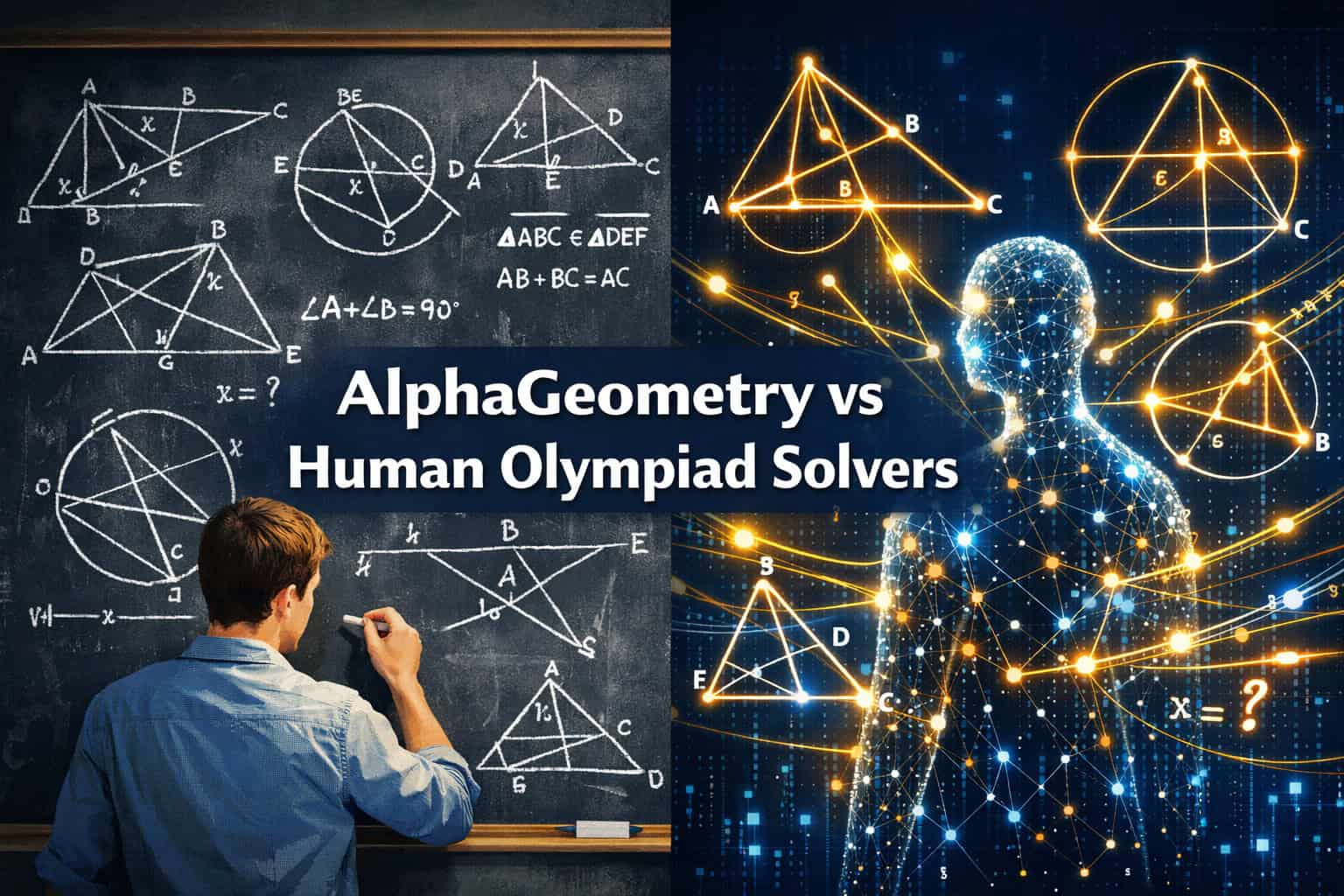
AlphaGeometry demonstrated that AI can solve complex, multi-step geometric reasoning problems at a level previously thought to require human intuition. In benchmark testing, it solved 25 of 30 Olympiad-level problems within the standard time limit. The previous best AI system managed only 10 [1].
The Architecture Behind the Breakthrough
AlphaGeometry uses a two-part system [1]:
- A neural language model that predicts which geometric constructs to add to a diagram (analogous to human intuition about where to draw an auxiliary line)
- A symbolic deduction engine that applies formal logical rules to verify each step rigorously
These two components work in a loop. The neural model suggests a move; the symbolic engine checks whether it leads anywhere useful. This mirrors how strong human mathematicians work: intuition guided by rigor.
The Training Data Problem (and How They Solved It)
One of the biggest obstacles in AI geometry has always been the lack of labeled training data. Human-annotated geometry proofs are rare and expensive to produce. DeepMind’s team bypassed this entirely by generating 100 million unique synthetic geometry problems and proofs without any human demonstrations [1].
“Training on 100 million synthetic examples without human input is a blueprint for how AI can bootstrap expertise in domains where labeled data is scarce.”
AlphaGeometry 2: Broader Coverage
The original AlphaGeometry had a narrow problem representation. AlphaGeometry 2, published in February 2025, expanded the system to handle problems involving object movements and linear equations of angles, ratios, and distances. It now covers 88% of IMO geometry questions from 2000 to 2024 [6].
Common mistake: Assuming AlphaGeometry is only relevant to academic mathematics. Its architecture, specifically the combination of neural prediction with symbolic verification, is already influencing how AI handles geometric reasoning in engineering and design software.
How Is AI Changing CAD and Engineering Geometry Workflows?

AI is automating the most time-consuming parts of the CAD-to-simulation pipeline. Tasks that required hours of expert manual work, like geometry segmentation, defeaturing, and mesh generation, now take seconds with deep learning models [2].
Key AI Techniques in CAD Geometry
| Task | Traditional Method | AI Method | Time Saved |
|---|---|---|---|
| Geometry segmentation | Manual annotation | CNNs on B-rep data | Hours → seconds |
| Defeaturing | Rule-based filters | GNN classification | Hours → minutes |
| Mesh quality prediction | Trial and error | Neural regression | Multiple iterations → one pass |
| Volumetric parameterization | Manual polycube mapping | DL-Polycube / DDPM-Polycube | Days → minutes |
B-rep (Boundary Representation) is the standard format for CAD geometry, representing shapes as collections of surfaces, edges, and vertices. AI models, including Convolutional Neural Networks (CNNs), Graph Neural Networks (GNNs), and Transformers, have been adapted to work directly with B-rep data rather than requiring conversion to simpler formats [2].
Deep Learning for Mesh Generation
Fully automated volumetric parameterization, which converts complex 3D shapes into structured meshes for simulation, has historically required significant expert intervention. Methods like DL-Polycube use neural templates to predict polycube structures, while DDPM-Polycube applies diffusion models to the same problem. Both achieve high-quality results with minimal human input [2].
Choose AI-assisted CAD if: your team spends more than 30% of simulation prep time on geometry cleanup. The ROI from automation is immediate and measurable.
Edge case: Highly irregular or topologically complex geometries (e.g., organic shapes with many holes) still challenge current AI mesh tools. Human review remains important for these cases.
How Is Machine Learning Transforming Shape Design for Designers and Creatives?

For designers, the AI revolution in geometry means generative tools that can propose, vary, and optimize shapes based on constraints or aesthetic goals. This is already embedded in professional design workflows.
Generative Adversarial Networks (GANs) have been part of engineering design since around 2020, proving effective for automotive component design and parametric shape optimization [5]. In 2026, similar generative approaches power shape suggestion features in design platforms.
What This Looks Like in Practice
- Parametric shape generation: A designer sets constraints (e.g., “a logo mark that is rotationally symmetric and fits within a 100px circle”), and the AI proposes dozens of variations
- Shape recognition in design tools: Upload a hand-drawn sketch; AI identifies and converts it to clean vector geometry
- Layout geometry: AI predicts optimal grid structures for UI layouts based on content type and screen size
For designers working with tools like Figma, AI-assisted geometry is increasingly built into core workflows. If you’re exploring how AI fits into your design process, the best AI graphic design tools for creative workflows covers the current landscape well. You can also explore how Figma AI workflow automation is changing day-to-day design tasks.
Practical tip: AI shape tools work best when you give them clear constraints. Open-ended prompts like “make something interesting” produce mediocre results. Specific constraints like “symmetrical, four-sided, with rounded corners, maximum 20% negative space” produce useful outputs.
For a broader look at how AI is changing visual design tools, the Design Archives at WebAiStack is a useful ongoing resource.
What Is Geometric Deep Learning and Why Does It Matter Beyond Design?

Geometric deep learning is a branch of machine learning that works with data that has an inherent geometric structure: graphs, meshes, point clouds, and manifolds. Standard neural networks assume data lives on a flat grid (like pixels in an image). Geometric deep learning handles data that lives on curved surfaces, networks, or irregular structures.
The core insight is that many real-world problems have symmetries that should be preserved during learning. A molecule rotated 90 degrees is still the same molecule. A road network is still the same network regardless of how you orient the map. Standard neural networks ignore these symmetries and must learn them from scratch. Geometric deep learning builds them in [3].
Applications Across Industries
Drug discovery: Molecules are naturally represented as geometric graphs. Geometric deep learning predicts physicochemical properties of drug compounds by respecting the 3D geometry of atoms and bonds, accelerating development pipelines from early screening through to clinical stages [3].
Medical imaging: Shape recognition in 3D scans (MRI, CT) relies on geometric deep learning to identify anatomical structures regardless of patient orientation or size variation.
Robotics and autonomous systems: Understanding the 3D geometry of environments in real time requires models that can process point cloud data from LiDAR sensors, a natural fit for geometric deep learning methods.
Architecture and structural engineering: Analyzing stress distributions across irregular 3D geometries benefits from graph-based neural approaches that respect the topology of the structure.
“Geometric deep learning doesn’t just add geometry to AI. It makes AI geometry-aware from the ground up, which changes what problems become tractable.” [3]
What Are the Practical Limits and Risks of AI in Geometry?
No technology reshapes a field without introducing new failure modes. The AI revolution in geometry is no exception.
Known Limitations
- Generalization gaps: AI geometry models trained on one domain (e.g., mechanical parts) often perform poorly on another (e.g., architectural forms) without retraining
- Interpretability: When an AI system suggests a geometric construction or shape modification, it often cannot explain why. This is a problem in high-stakes engineering contexts where auditability matters
- Data dependency: Systems like AlphaGeometry solved the training data problem with synthetic generation, but many applied AI geometry tools still require large domain-specific datasets that smaller organizations cannot easily produce
- Topological errors: AI mesh generation tools can produce geometrically plausible but topologically invalid meshes (e.g., non-manifold surfaces) that break downstream simulation software [2]
Common Mistakes When Adopting AI Geometry Tools
- Treating AI output as final. AI geometry suggestions always need expert review, especially in engineering and medical contexts.
- Skipping validation pipelines. Automated mesh generation should always feed into a quality-check step before simulation.
- Over-relying on benchmark scores. AlphaGeometry’s IMO performance is impressive, but IMO problems are well-defined. Real engineering geometry is messier.
- Ignoring domain shift. A model that works well on your test set may fail on production data if the geometry distribution differs.
If you’re integrating AI tools into web or digital design workflows, understanding how AI fits into broader content and design systems is helpful. The guide on AI-powered content optimization covers adjacent principles that apply to AI-assisted design work.
How Is the AI Revolution in Geometry Shaping the Future of Design Tools?
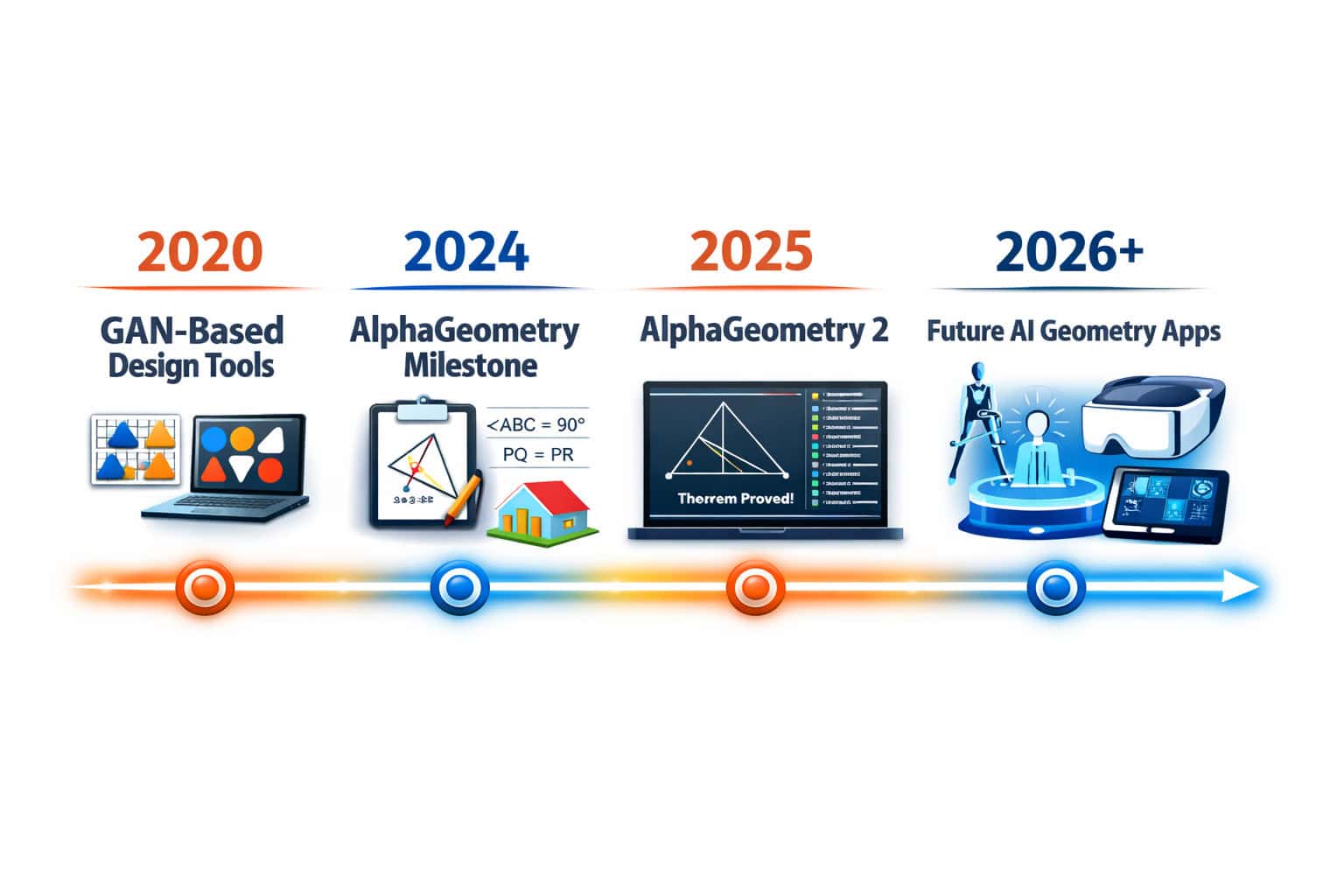
The trajectory is clear: geometry-aware AI is moving from research labs into everyday tools. By 2026, several shifts are already visible.
What’s Already Happening
- AI shape libraries in design tools that suggest geometrically consistent components based on existing design systems
- Automated layout geometry in UI tools that respects grid mathematics and spacing rules without manual adjustment
- Real-time shape recognition in mobile apps that converts sketches to structured vector geometry instantly
- Generative 3D modeling tools that produce parametric shapes from text or sketch input, using architectures descended from GAN and diffusion model research [5]
What’s Coming Next
Based on current research trajectories (not speculation):
- Tighter integration between symbolic geometry engines (like AlphaGeometry’s deduction component) and generative design tools
- AI systems that can verify geometric constraints in real time as designers work, flagging violations before they become problems
- Cross-domain geometric transfer learning, where a model trained on molecular geometry can inform architectural form-finding
For designers who want to stay ahead of these shifts, exploring Figma for beginners: mastering UI/UX design principles provides a strong foundation in the geometric principles that AI tools are now augmenting. Similarly, understanding Figma UI kits and design systems helps you see how structured geometric thinking already underpins modern design workflows.
FAQ: AI Revolution in Geometry
Q: What is AlphaGeometry and why does it matter? AlphaGeometry is a Google DeepMind AI system that solved 25 of 30 International Mathematical Olympiad geometry problems, matching human gold medalist performance. It matters because it demonstrated that AI can perform complex multi-step geometric reasoning, not just pattern recognition [1].
Q: How is AI used in CAD software today? AI automates geometry segmentation, defeaturing, and mesh generation in CAD pipelines. Deep learning models including CNNs and GNNs work directly with B-rep geometry to classify features and predict mesh quality, replacing hours of manual work [2].
Q: What is geometric deep learning? Geometric deep learning is a branch of machine learning designed for data with inherent geometric structure, like graphs, point clouds, and surfaces. It builds in symmetries (rotational, translational) that standard neural networks must learn from scratch, making it especially effective for molecular data and 3D shape analysis [3].
Q: Can AI generate new geometric shapes for design? Yes. Generative models including GANs and diffusion models can produce novel geometric shapes based on constraints or style inputs. These are already used in automotive design, parametric architecture, and digital design tools [5].
Q: What percentage of IMO geometry problems can AlphaGeometry 2 solve? AlphaGeometry 2 covers 88% of IMO geometry questions from 2000 to 2024, a significant expansion from the original version’s narrower problem representation [6].
Q: Does AI geometry work without large amounts of training data? AlphaGeometry bypassed the data problem by generating 100 million synthetic training examples without human demonstrations. This approach is increasingly used in other AI geometry applications where labeled data is scarce [1].
Q: What are the main risks of using AI for geometry in engineering? Key risks include topologically invalid mesh outputs, poor generalization across different geometry domains, and lack of interpretability. All AI geometry outputs in engineering contexts should go through a validation step before use in simulation [2].
Q: Is geometric deep learning the same as computer vision? No. Computer vision typically works with 2D images on regular grids. Geometric deep learning handles irregular structures like 3D meshes, molecular graphs, and point clouds where standard convolution does not apply [4].
Q: How do design tools like Figma use AI geometry features? Current AI geometry features in design tools include automatic layout alignment, shape suggestion, sketch-to-vector conversion, and component spacing optimization. These are built on the same machine learning principles as research systems, adapted for design workflows.
Q: What industries benefit most from AI geometry today? Engineering and manufacturing (CAD automation), pharmaceutical research (drug discovery via geometric deep learning), architecture (generative form-finding), and digital design (parametric shape generation) are the most mature application areas as of 2026.
Q: How do I start using AI geometry tools as a designer? Start with the AI features already in tools you use (Figma, Canva). Then explore dedicated AI graphic design tools that include shape generation. The best AI graphic design tools for creative workflows is a good starting point.
Q: Will AI replace human geometric designers? Not in the foreseeable future. AI geometry tools are strong at generating variations, automating repetitive tasks, and optimizing within defined constraints. They are weak at understanding context, intent, and the cultural meaning of shapes. Human judgment remains essential.
Conclusion: What to Do With This Information
The AI revolution in geometry is not a future event. It is happening now, across mathematics, engineering, drug discovery, and digital design. The systems doing this work, from AlphaGeometry’s hybrid neural-symbolic architecture to GNN-based CAD automation to geometric deep learning for molecular science, are already delivering measurable results.
Here are concrete next steps based on your role:
- Engineers and CAD professionals: Audit your geometry cleanup workflow. If defeaturing and segmentation take more than a few hours per project, evaluate AI-assisted tools now. Start with a pilot on one part family.
- Designers: Activate and experiment with the AI shape and layout features already in your tools. Combine AI generation with your own geometric judgment rather than treating outputs as final.
- Researchers and data scientists: If your data has natural geometric structure (molecules, networks, 3D scans), geometric deep learning is worth evaluating. The symmetry-aware architectures outperform standard neural networks on these tasks.
- Learners and educators: Study AlphaGeometry’s architecture. The neural-symbolic combination is a pattern that will appear in many future AI systems, not just geometry.
The underlying shift is this: geometry is no longer just a domain that AI works on. It is becoming a domain that AI works with, as a first-class representation of the world. That changes what’s possible in nearly every field that deals with shape, space, and structure.
For more on how AI is changing design workflows specifically, explore the AI category at WebAiStack for ongoing coverage.
References
[1] AlphaGeometry: An Olympiad-Level AI System for Geometry – https://deepmind.google/blog/alphageometry-an-olympiad-level-ai-system-for-geometry/
[2] AI in CAD Geometry: Deep Learning for Segmentation and Mesh Generation – https://arxiv.org/html/2512.23719v1
[3] Symmetries, Scaffolds, and a New Era of Scientific Discovery – https://thegradient.pub/symmetries-scaffolds-and-a-new-era-of-scientific-discovery/
[4] Towards Geometric Deep Learning – https://thegradient.pub/towards-geometric-deep-learning/
[5] Journal of Computational Design and Engineering: GANs in Engineering Design – https://academic.oup.com/jcde/article/13/1/1/8340357
[6] AlphaGeometry (Wikipedia) – https://en.wikipedia.org/wiki/AlphaGeometry